
CARD PAYMENTS GUIDE
Online Card Payments in Ireland: Gateways, Payment Links and Virtual Terminals
The ways to take card payments when the customer is not in front of you, from a simple payment link to a full website checkout, and how fees, security, refunds and payouts work for each.
The short answer
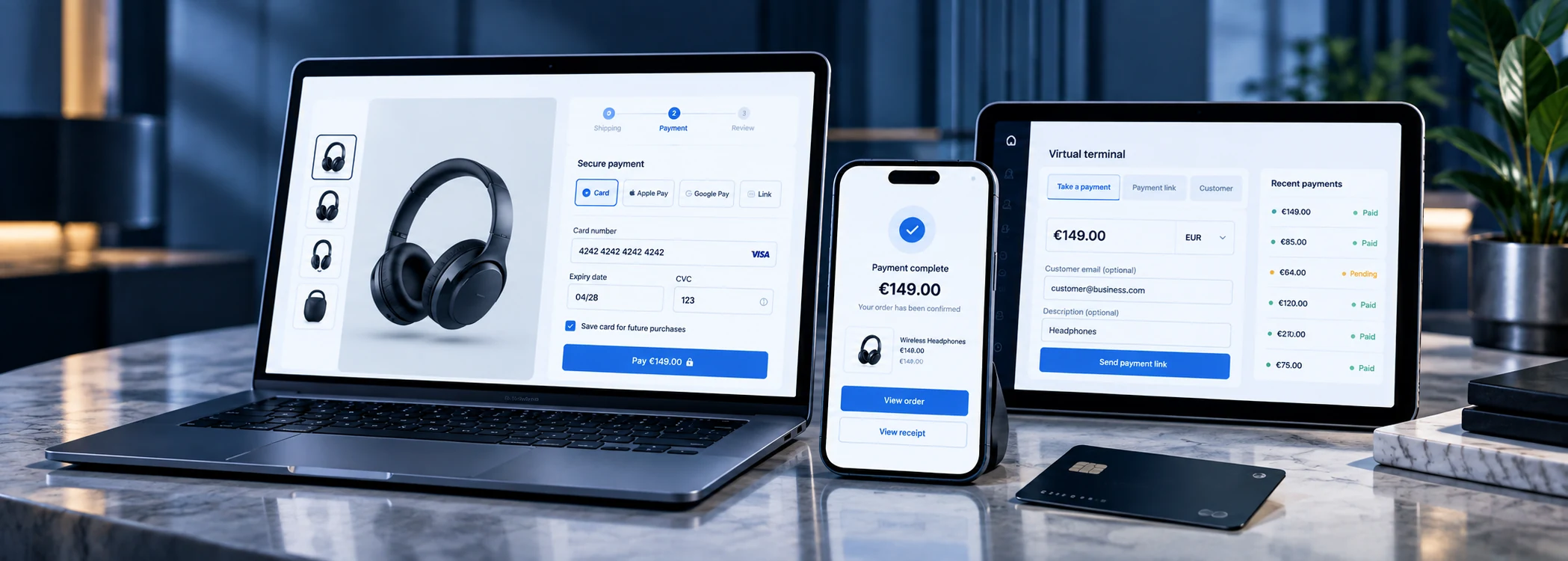
You can take card payments online in Ireland without building an online shop. For occasional or one-off payments, a payment link or an invoice with a pay button is often enough. For phone orders, a virtual terminal lets you key in card details. If you sell regularly through a website, you need a checkout connected to a payment gateway, either hosted by the provider or embedded in your site.
Online card payments cover any payment where the card is not physically presented to you: a customer buying from your website, paying a deposit through a link you texted them, settling an invoice, or reading their card number to you over the phone. Each method has its own set-up effort, cost and risk, and the table below shows which suits which kind of business.
Which online payment method suits your business?
| Method | Best for | Website needed? | Set-up effort |
|---|---|---|---|
| Payment link | Deposits, one-off orders, selling through social media or messaging | No | Minutes |
| Invoice with pay button | Trades, professional services, business customers | No | Low |
| Virtual terminal | Phone orders and bookings | No | Low |
| Hosted checkout | Small online shops and booking sites | Yes | Low to medium |
| Embedded checkout | Businesses wanting full control of the checkout design | Yes | Medium to high |
| Ecommerce platform payments | Online shops built on a website builder or shop platform | Yes | Low |
| Recurring and card-on-file | Memberships, subscriptions, retainers and repeat customers | Optional | Medium |
What a payment gateway does
When a customer presses "Pay", the gateway encrypts their card details, routes the request through the card network to the customer's bank, and brings back a yes or no, usually within a few seconds. Behind it sits an acquirer, which settles the money into your account.
In the past, businesses often signed up for a gateway and a merchant account separately. Most providers serving small businesses in Ireland now bundle both into one account, so a single sign-up gives you the gateway, the processing and the payouts. If you already have a merchant account through a bank, you may still need a separate gateway to connect it to your website.
Hosted vs embedded checkout
Hosted checkout
With a hosted checkout, the customer clicks "Pay" on your website and is taken to a payment page run by your provider, then returned to your site once they have paid. The provider handles the card form, security and authentication.
- Pros: quick to set up, the least security responsibility for you, and the provider keeps the page up to date with new payment methods and rules.
- Cons: less control over design, and a short redirect that some customers notice.
Embedded checkout
An embedded checkout places the payment form inside your own page, usually using secure fields or a component supplied by the provider. The customer never appears to leave your site.
- Pros: a seamless experience, full control over layout and branding, and more flexibility for complex baskets or bookings.
- Cons: more development work, more testing, and more to maintain as your site changes.
For most small businesses, a hosted checkout or the built-in payments on your ecommerce platform are the sensible starting point.
Payment links: take payments without a website
A payment link is a secure web address for a set amount, or sometimes an amount the customer chooses. You create it in your provider's app or dashboard and send it by email, text, WhatsApp or social media. The customer opens it, enters their card or uses a digital wallet, and you are notified when they have paid.
Payment links suit:
- deposits for bookings, events or commissions;
- catering, custom and made-to-order work;
- businesses selling through Instagram, Facebook or messaging;
- anyone who wants to take a remote payment without a website.
Some providers also let you create a reusable link or QR code for a fixed product, such as a class pass or voucher.
Invoices with a "Pay now" button
Adding a "Pay now" button to invoices lets customers pay by card from the email. Many accounting packages connect to payment providers so that the invoice is marked paid and reconciled automatically when the payment comes in, and some payment providers have their own invoicing tools.
This is often the biggest single improvement for trades and professional services, because it removes the friction of bank transfer details and tends to get invoices paid sooner. Check the rate that applies: some providers charge invoice payments at a different rate from standard online checkout.
Virtual terminals for phone payments
A virtual terminal is a payment screen in your browser or app where you type in the card details a customer gives you, typically over the phone. It turns any computer into a card machine for remote orders.
Virtual terminal payments are "card not present" and the customer is not authenticating the payment themselves, so they usually cost more and carry a higher risk of disputes. Use them for genuine phone orders, never ask customers to send card details by email or text, and never write them down. Where you can, send a payment link instead, so the customer enters their own details and can confirm the payment with their bank.
Recurring payments and card-on-file
Recurring or subscription payments charge a customer automatically on a schedule, such as a monthly gym membership, a software subscription or a veg box. Card-on-file payments store a customer's card securely with your provider so you can charge it later with their permission, for example a no-show fee, a balance after a job, or a regular client's monthly bill.
The card details are held by the provider, not by you. You need the customer's clear agreement to the terms at the outset, including how much and how often they will be charged and how to cancel. Clear terms and reminders before renewals reduce disputes. Check how each provider handles expired or replaced cards, failed payments and retries, and what it charges for card-on-file payments, which may be priced differently from standard checkout.
Connecting payments to your website
Shop platforms and website builders
If your website runs on a website builder or ecommerce platform, start with what it supports. Most offer built-in payments or official plug-ins for a small number of providers. Before choosing a provider, check:
- whether the platform supports it officially, and who maintains the plug-in;
- whether the platform charges its own transaction fee on top when you use an outside provider;
- which payment methods and wallets appear at checkout;
- how refunds are issued, from the platform or from the provider's dashboard.
Custom website integrations and APIs
For a custom-built site or booking system, you or your developer will connect through the provider's API (application programming interface). Things to discuss with your developer:
- Documentation and test mode: good documentation and a full test environment save time and cost.
- Webhooks: automatic notifications from the provider when a payment succeeds, fails, is refunded or disputed, so your system stays in step.
- Authentication: the checkout must handle strong customer authentication, covered below.
- Security: using the provider's hosted fields or components keeps card data off your servers.
- Maintenance: who updates the integration when the provider or your site changes.
Online card payment fees
Online payments usually cost more than in-person ones, and most add a fixed fee to every payment. Published standard online rates for EEA consumer cards, checked on 28 September 2026, ran from 1% + €0.20 to 1.5% + €0.25 across the providers on our card payment provider comparison. The method matters too: Square, for example, charged 2.5% + VAT for invoices, its Virtual Terminal and card-on-file payments, a higher percentage than its standard online checkout rate.
The fixed element hurts most on small orders. On a €10 order, a 25c fixed fee alone is 2.5% of the sale. For how percentage fees, fixed fees and monthly charges add up across a month, see card payment fees in Ireland explained.
Selling to customers outside the EEA
Selling online often means selling beyond Ireland. Cards issued outside the EEA, including UK cards, usually cost more to accept, and converting a payment from another currency can add a further charge; on published rates, a €100 sale on a non-EEA card with conversion can cost around three times as much as the same sale on an Irish card. Our fees guide sets out international card and conversion fees with a worked example.
If UK or other overseas customers are a real share of your sales, decide whether to price in euro only or show local currencies, and compare providers on the rates for the cards your customers actually use.
Fraud, 3D Secure and PCI compliance
Strong customer authentication and 3D Secure
EU payment rules require strong customer authentication for many online card payments. In practice, the customer confirms the payment in their banking app or with a code, a process known as 3D Secure. It reduces fraud and, when a payment is authenticated, generally shifts liability for fraud-related chargebacks away from you. Hosted checkouts, payment links and major ecommerce platforms handle it automatically; custom integrations must be built to support it.
Fraud screening
Most providers screen online payments for signs of fraud and may block or flag risky ones. Check what is included, whether you can set your own rules, and whether advanced screening costs extra. Warning signs to watch for yourself include unusually large first orders, several failed attempts with different cards, and mismatched billing and delivery details.
PCI DSS compliance
The Payment Card Industry Data Security Standard (PCI DSS) applies to every business that accepts cards. Using a hosted checkout, payment links or the provider's secure fields means card details never touch your systems, which keeps your compliance simple, usually a short annual self-assessment. Building your own card form that handles raw card data brings far heavier obligations and is rarely worth it for a small business.
Refunds and chargebacks on online sales
Online sales generate more refunds and disputes than in-person sales, because the customer has not seen the product or service yet. Publish a clear refund and cancellation policy, and make it easy to find before checkout. Irish consumers also have statutory rights when buying online, including cancellation rights for many distance purchases, so your policy must reflect those.
When a customer disputes a payment with their bank (a chargeback), the funds are withdrawn from your balance while it is reviewed, and you can submit evidence. Keep order confirmations, delivery tracking, communications and proof that the customer agreed to your terms. Check whether your provider returns fees on refunds and whether it charges per dispute.
Payouts from online payments
Online takings are paid out like in-person ones: the provider deducts its fees and transfers the balance to your bank account on a schedule, typically within one to a few working days. Our provider comparison lists each provider's published payout terms.
The online-specific risk is a hold on your money. If you take large deposits or sell goods for later delivery, a provider may keep back a reserve or delay payouts until orders are fulfilled. Ask about this at sign-up if it applies to you.
Payment link or full ecommerce checkout?
It depends on how often you sell online and what you sell.
A payment link or invoice is usually enough if:
- you take a handful of online payments a week;
- each sale is individually agreed, such as a quote, booking or custom order;
- you sell through conversations on social media, email or messaging;
- you do not need stock control or a product catalogue online.
A full ecommerce checkout makes sense if:
- customers buy without talking to you first;
- you sell a range of products with fixed prices and stock levels;
- you need delivery options, discount codes or basket totals;
- you want sales and stock synchronised with your shop or till.
Many businesses start with payment links and move to a full checkout as online sales grow. If you plan to do both online and in person, a provider that handles both keeps your reporting and payouts in one place. Our guide on how to accept card payments in Ireland covers setting up an account, verification and testing before you go live.
Online card payments: frequently asked questions
Can I accept card payments online without a website?
Yes. Payment links, invoices with a card payment button and virtual terminals all work without a website. You can send links by email, text or messaging apps.
What is the difference between a payment gateway and a payment provider?
The gateway is the technology that sends card details from your checkout for approval. A payment provider usually supplies the gateway together with the merchant account and payouts, so most small businesses sign up for one service rather than two.
Are payment links safe?
Payment links from established providers use secure, hosted payment pages, and the customer can authenticate the payment with their bank. To protect customers from scams, send links from a recognisable business name and tell customers to expect them.
Why are online card fees higher than in-person fees?
Online payments carry a higher risk of fraud and disputes because the card is not physically present. Providers price that risk into their online rates, often with a fixed fee per payment.
Can I take card payments over the phone?
Yes, using a virtual terminal to key in the customer's card details. Alternatively, send the customer a payment link during the call so they enter their own details, which is usually safer and may cost less.
Where to go next
-
Compare card payment providers in Ireland
Online and in-person rates, hardware and payout terms side by side.
-
Card payment fees explained
Every type of card charge, with worked examples for different businesses.
-
How to accept card payments in Ireland
A step-by-step guide to getting set up, verified and paid.
General information, not legal or financial advice. Provider figures are published standard rates checked on 28 September 2026; confirm current terms with the provider before you sign up.